Search Products | My Account | Shopping Cart   
GeneCopoeia – ORF cDNA, shRNA, miRNA
   You are here: Home > Product > Ires >

Bicistronic or Internal Ribosome Entry Site (IRES) Element — Efficient co-expression of two genes in a single vector

The IRES element is exactly what's needed for certain experiments when a single-gene vector falls short. IRES enables the coordinated co-expression of two genes with the same vector. For example, you can monitor the delivery of one gene by using a second gene with a fluorescent tag or express a protein of interest and simultaneously biotinylate it with the same vector. An IRES element is especially useful for gene delivery when working with stem and primary cells and when the following tasks are pursued:
  • Monitor gene delivery efficiency
  • Monitor protein modification
  • In vivo biotinylation
  • Stable transfection

Technology

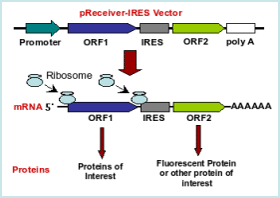
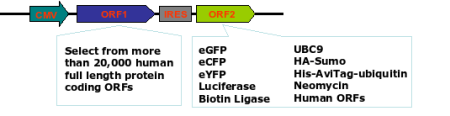
The IRES technology serves a dual-purpose. It allows the coordinated and efficient expression of two genes using the same promoter in a single vector (see figures 1 and 2). Virtually any combination of genes is possible. GeneCopoeia has already developed many constructs.

Combined with OmicsLink expression-ready clones

For a variety of applications, GeneCopoeia has incorporated the IRES element into several mammalian and lentiviral vectors using a wide choice of reporter genes including the following:

  • eGFP
  • mCherry
  • SUMO
  • biotin ligase
  • neomycin
  • luciferase

More than 20,000 human and 15,000 mouse genes are available in CMV promoter driven bicistronic (IRES) expression vectors.

Choice of co-expressing any reporter gene with IRES element
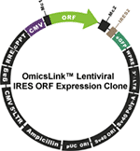
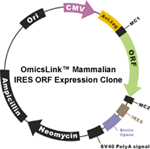
OmicsLink ORF cDNA clones with IRES element

OmicsLink ORF cDNA clones with IRES element

Figure1. OmicsLink™ ORF cDNA expression clones with IRES element in mammalian and lentiviral expression vector systems.

Advantages

  • Minimal affect on biological activities of target proteins when co-expressed with reporter/ assaying genes.
  • Efficient co-transfection due to coordinated co-expression of two genes from a single expression vector.

Applications

  • Monitor gene delivery efficiency by co-expressing proteins with reporter genes including eGFP, mCherry or Luciferase.
  • Monitor protein modification by a specific modifier in vivo by co-expressing proteins with protein modifiers such as Sumo.
  • In vivo biotinylation of expressed proteins with AviTag by co-expressing with biotin ligase.
  • Establish stable transfected cell lines for efficient selection by co-expressing with selection marker genes like Neomycin.

How it works

Schematic of protein expression with IRES technology


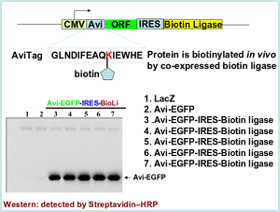
Specific biotinylation of AviTag eGFP by E. coli biotin ligase in 293 cells

Figure 2. Specific biotinylation of AviTag eGFP by E. coli biotin ligase in 293 cells

List of expression vectors with IRES technology

Vector Promoter Host Cell Selection marker Tag Protease site
pReceiver-M45 CMV Mammalian Neomycin C-3xHA+ IRES-eGFP N/A
pReceiver-M46 CMV Mammalian Neomycin C-Flag+ IRES-eGFP N/A
pReceiver-M47 CMV Mammalian Neomycin C-Myc+ IRES-eGFP N/A
pReceiver-M48 CMV Mammalian Neomycin N-Avi+ IRES-Biotin ligase N/A
pReceiver-M60 CMV Mammalian Neomycin IRES-eGFP N/A
pReceiver-Lv31 CMV Stem/primary cell No IRES-eGFP N/A
pReceiver-Lv81 CMV Stem/primary cell N/A IRES2-eGFP N/A
pReceiver-Lv36 CMV Stem/primary cell No IRES-luciferase N/A
pReceiver-Lv40 CMV Stem/primary cell Neomycin IRES-Neomycin N/A
pReceiver-Lv32 CMV Stem/primary cell No C-3xHA + IRES-eGFP N/A
pReceiver-Lv52 CMV Stem/primary cell N/A C-3xHA+IRES2-eGFP N/A
pReceiver-Lv33 CMV Stem/primary cell No C-Flag + IRES-eGFP N/A
pReceiver-Lv53 CMV Stem/primary cell N/A C-Flag+IRES2-eGFP N/A
pReceiver-Lv35 CMV Stem/primary cell No N-Avi + IRES-Biotin ligase N/A
pReceiver-Lv43 CMV Stem/primary cell No C-Myc+ IRES-eGFP N/A
pReceiver-Lv70 CMV Stem/primary cell N/A C-Myc+IRES2-eGFP N/A
pReceiver-Lv44 CMV Stem/primary cell No C-Myc+ IRES-eYFP N/A
pReceiver-Lv47 CMV Stem/primary cell Neomycin C-Myc+IRES-Neomycin N/A
pReceiver-Lv69 CMV Stem/primary cell N/A C-Myc+IRES-mCherry N/A

Learn more about expression-ready ORF cDNA clone collection available in bacterial, mammalian, insect, yeast and wheat germ cell free systems with more than 50 fusion tags.

Rigorous quality control and assurance process

All ORF cDNA clones in OmicsLink collection were generated from sequence validated full-length cDNA clones or high-quality human tissue cDNA libraries to construct expression-ready clones.

Once the clone is constructed, GeneCopoeia follows additional quality control processes to ensure the right clone is delivered.

  • All ORF cDNA are fully sequenced.
  • PCR amplification and size validation
  • Enzyme digestion check of the integrity of whole plasmid

References

  1. Moroz MA, Serganova I, Zanzonico P, Ageyeva L, Beresten T, Dyomina E, Burnazi E, Finn RD, Doubrovin M, Blasberg RG. Imaging hNET Reporter Gene Expression with 124I-MIBG. J Nucl Med. 2007 May;48(5):827-836.
  2. Allera-Moreau C, Chomarat P, Audinot V, Coge F, Gillard M, Martineau Y, Boutin JA, Prats AC. The use of IRES-based bicistronic vectors allows the stable expression of recombinant G-protein coupled receptors such as NPY5 and histamine 4.Biochimie. 2006 Jun;88(6):737-46. Mulky A, Sarafianos SG, Arnold E, Wu X, Kappes JC. Subunit-specific analysis of the human immunodeficiency virus type 1 reverse transcriptase in vivo. J Virol. 2004 Jul;78(13):7089-96.
  3. Harries M, Phillipps N, Anderson R, Prentice G, Collins M. Comparison of bicistronic retroviral vectors containing internal ribosome entry sites (IRES) using expression of human interleukin-12 (IL-12) as a readout.J Gene Med. 2000 Jul-Aug;2(4):243-9. Fujiwara T, Urata Y, Tanaka N. lomerase-specific oncolytic virotherapy for human cancer with the hTERT promoter. Curr Cancer Drug Targets. 2007 Mar;7(2):191-201.
  4. Martinez-Salas E. Internal ribosome entry site biology and its use in expression vectors. Curr Opin Biotechnol. 1999 Oct;10(5):458-64. D Trouet, B Nilius, T Voets, G Droogmans, J Eggermont. Use of a bicistronic GFP-expression vector to characterise ion channels after transfection in mammalian cells. Pflugers Arch (1997) 434: 632-8.

   Copyright© 2001-2010 GeneCopoeia, Inc. All Rights Reserved. Contact us | License | Privacy